What are the cooling measures for F-series parallel axis gear reducers
1、 Basic passive cooling
Natural cooling of shell heat dissipation ribs: Heat dissipation ribs are cast into the gearbox body as a whole, relying on natural convection to take away heat, which is a standard solution for F series low-power models.
Applicable scenarios: light load intermittent working conditions with power ≤ 5kW, ambient temperature ≤ 35 ℃, and good ventilation.
Installation requirements: The heat dissipation ribs should be directed towards the natural airflow, with a reserved unobstructed space of ≥ 200mm around to avoid heat accumulation.
2、 Forced air cooling
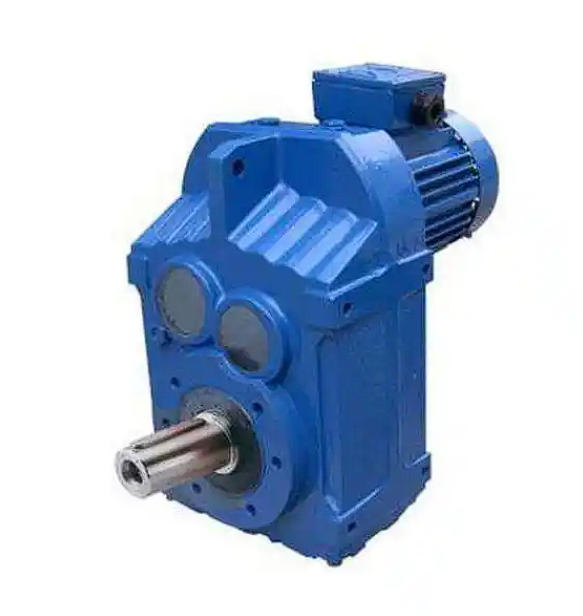
Shaft end direct connection fan cooling: Install a coaxial fan at the non output end of the high-speed shaft to supply air synchronously with the operation of the reducer, and the airflow completely covers the heat dissipation ribs of the housing.
Negative pressure ventilation and cooling of the box: An inlet and outlet air duct is opened on the box cover, and an external centrifugal fan is connected to form a slight negative pressure inside the box, directly discharging the hot air inside while achieving negative pressure sealing and oil leakage prevention.
Applicable scenario: Under normal continuous working conditions with a power of 5-30kW and an ambient temperature of ≤ 40 ℃, the fan air volume is configured to be ≥ 1.5m ³/min · kW.
3、 Liquid cooling system
Built in serpentine water cooling tube: copper/brass serpentine cooling water tubes are arranged in the oil tank, and circulating cooling water is introduced to directly remove the heat of lubricating oil.
External oil cooling circulation system: An independent air-cooled/water-cooled oil cooler is installed outside the gearbox to extract and cool the hot oil in the box before returning it, with a circulation flow rate of 3-5 times the gearbox oil volume per hour.
Applicable scenario: For heavy-duty continuous working conditions with a power greater than 30kW, the water-cooled heat exchange area should be selected as ≥ 0.05m ²/kW, and the water quality should be softened water with a pH value of 6.5-8.5.
4、 Special customized cooling solution
Hybrid cooling: Simultaneously equipped with two or more cooling methods such as air cooling+water cooling, air cooling+oil cooling, etc., to make up for the shortcomings of a single solution and adapt to extreme working conditions of high temperature and high load.
Local device cooling: Install micro coolers for core hot spots such as high-speed bearings and meshing tooth surfaces to accurately control temperature and avoid local hot spot overheating failure.
Negative pressure sealed ventilation cooling: While discharging hot air from the box, it maintains a slight negative pressure inside, which not only cools down but also solves the problem of sealing oil leakage caused by positive pressure in the box at high temperatures.