What are the common issues in the welding of NGW42-25 planetary gear reducer housings
1、 Common welding defects in the weld seam body
Surface defects: porosity, undercutting, weld bead, and spatter residue in the weld seam are often caused by the welding material not being dried, excessive welding current, or inadequate cleaning.
Internal defects: There are incomplete penetration, slag inclusion, and hidden cracks inside the weld seam, which are caused by non-standard groove processing and incomplete slag removal between multiple layers of welding.
Special material defects: When welding cast iron machine bases, white hard and brittle structures are easily generated, directly reducing the toughness of the weld and causing delayed cracking in the future.
2、 Welding deformation and out of tolerance in form and position accuracy
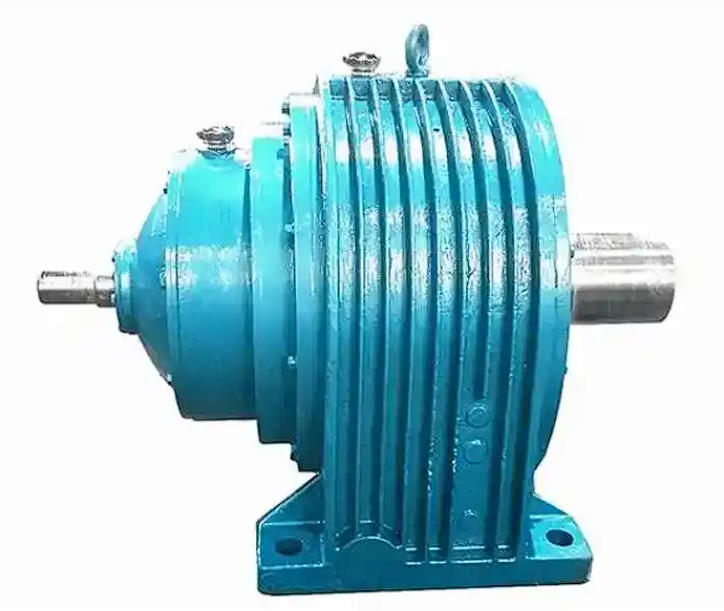
The key installation surfaces and bearing holes of the machine base are unevenly heated and warped, resulting in deviations of flatness and coaxiality exceeding 0.05mm, leading to the failure of subsequent planetary gear assembly accuracy.
Local deformation occurs in the stress concentrated areas such as the foundation flange and reinforcement bars, and there is a gap between the machine base and the equipment base. The vibration value exceeds the standard during operation.
The long weld seam was not welded symmetrically in sections, and the overall deformation exceeded the constraint range of the rigid fixed fixture, making it impossible to restore accuracy through subsequent correction.
3、 The problem of material and welding material compatibility failure
The actual material of the machine seat was not differentiated (HT250 cast iron, ZG270-500 cast steel, Q345B low-alloy steel), and ordinary carbon steel welding rods were mistakenly used, resulting in a mismatch in strength between the weld and the base material.
The low hydrogen welding rod was not baked at 350 ℃ for 2 hours as required, causing the welding material to absorb moisture and resulting in cold cracks in the weld seam, which rapidly expanded under stress.
The cast iron machine base did not use nickel based special welding rods, and was forcibly welded with ordinary carbon steel welding rods. The fusion of the weld seam was extremely poor, and it cracked again shortly after repair.
4、 Residual stress and hidden dangers of post weld failure
After welding, no insulation slow cooling or stress relief annealing was carried out, resulting in residual stress concentration in the weld and heat affected zone, and secondary cracking occurred under alternating loads during operation.
Before welding, no crack stopping holes were drilled at both ends of the crack. During the welding process, the crack continued to extend and the repair range was out of control.
During welding, precision components such as planetary gears and bearings inside the machine base were not disassembled in advance, resulting in permanent damage to the accuracy of transmission components due to high temperature conduction.
No kerosene leakage test was conducted after welding, and there are micro pores in the weld seam. During operation, the lubricating oil inside the machine base leaked, causing lubrication failure failure.