How much does the shape of the heat sink of ZSY400-50-4 reducer affect the heat dissipation efficiency
1. Balance between heat dissipation area and shape
The basic principle of a heat sink is to increase the contact area between the box and the air. For a medium power gearbox like ZSY400, common heat sink shapes include sheet, fin, tube, or corrugated.
Maximizing surface area: In the case of limited box volume, using corrugated or serrated heat sinks can significantly increase the effective heat dissipation area, thereby improving heat dissipation efficiency.
The trade-off between thickness and height: The thinner and higher the heat sink, the better. If the heat sink is too thin or too high, the ability of heat conduction to the top of the heat sink will weaken, resulting in a large temperature difference between the end and root of the heat sink. Even if the volume is increased, it cannot effectively improve the overall heat dissipation efficiency.
2. Spacing and air convection efficiency
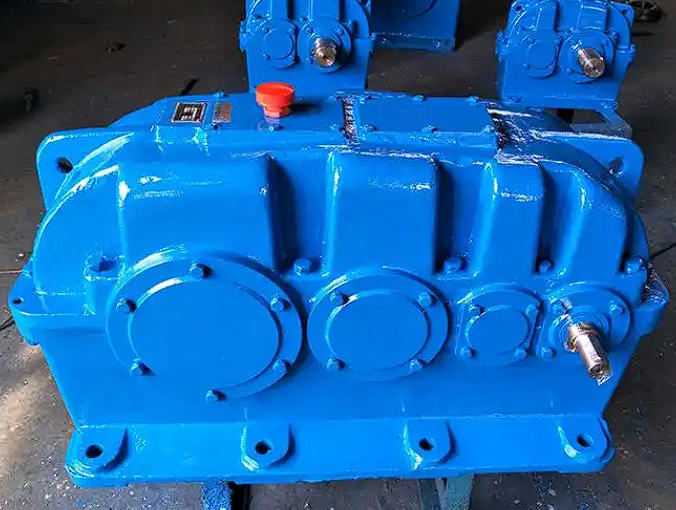
The spacing design of the heat sink directly affects whether the air can flow smoothly.
The critical point of natural convection: Air will form a 2mm thick air boundary layer on the surface of the heat sink. To ensure smooth natural convection, the spacing between heat sinks usually needs to be at least 4mm.
The disadvantage of narrow spacing: If the spacing is designed to be too narrow in order to increase the number of heat sinks, air flow will be obstructed, and the thermal boundary layer is prone to cross, which will greatly reduce the efficiency of natural convection heat dissipation.
The disadvantage of excessive spacing: If the spacing is too large, although the air circulation is smooth, it will lead to a reduction in the number of heat sinks and a decrease in the total heat dissipation area for the same volume.
3. Angle and surface treatment
Tilt angle: If the heat sink is designed with a tilt angle of about 3 degrees, it can help guide air flow, break through the obstruction of the air boundary layer, and thus improve the convective heat transfer coefficient.
Surface texture: Under natural convection conditions, excessive protrusions or complex ripples on the surface of the heat sink may hinder the flow of the air layer and reduce heat dissipation efficiency. Usually, blackening or anodizing the surface of the heat sink can effectively increase the radiation coefficient and enhance radiation heat dissipation.
4. Matching actual working conditions with cooling methods
In practical applications, the design of the heat sink shape of ZSY400-50-4 reducer also needs to be combined with its cooling method:
Natural cooling (fanless): relying on the built-in cast heat dissipation ribs of the casing, the shape, spacing, and angle design of the heat dissipation fins are crucial, directly determining the thermal equilibrium temperature of the gearbox.
Forced air cooling (with fan): If an axial fan is installed at the rear of ZSY400, the airflow direction becomes clear. At this point, needle shaped fins or transverse flat fins are more effective than traditional straight strip heat sinks because they can increase fluid disturbance, improve thermal conductivity, and needle shaped fins have isotropic properties, making them suitable for dealing with the rotating airflow generated by fans.