How to detect the center distance deviation of ZLY160-8-I reducer gears
1. Measuring backlash with a feeler gauge (most commonly used)
Operation: After installing the paired gear into the box, use a feeler gauge to evenly select 4-6 positions on the circumference of the gear and measure the meshing backlash of the gear.
Adjustment and judgment: Determine the standard backlash based on the gear module. If the side clearance is too large or too small, adjust the center distance by adding or removing adjusting shims at the bearing end cover. After adjustment, it is necessary to repeatedly measure until the lateral clearance deviation of all measurement positions is ≤ 0.03mm and the clearance is uniform.
2. Direct measurement method
Operation: Use an inside micrometer, vernier caliper, or coordinate measuring machine to directly measure the distance between the bearing holes on both sides of the housing, or measure the distance between the two shaft necks for indirect conversion.
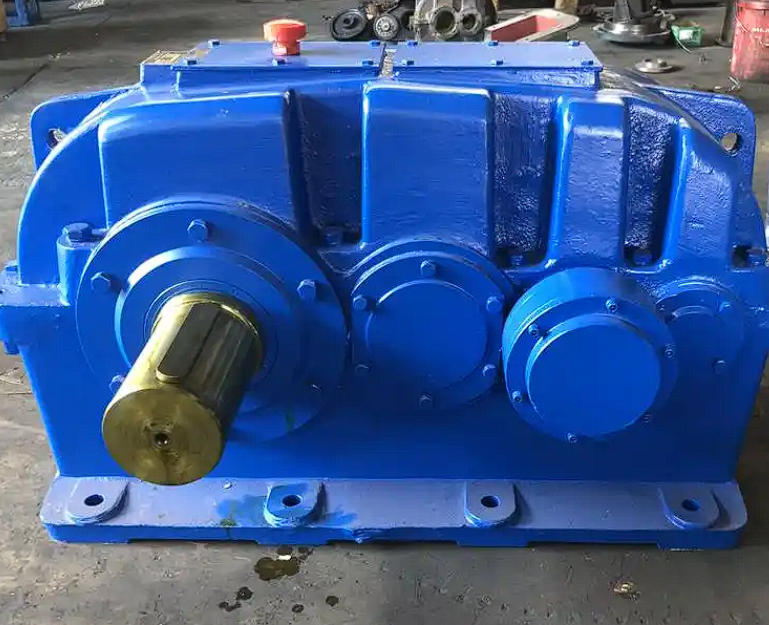
Standard: For ZLY160 reducers (with a center distance between 120-200mm), according to the general precision requirements of 7-8 levels, the allowable deviation of the center distance is usually ± 0.05mm.
2、 Laboratory and high-precision testing
If high-precision factory inspection or failure analysis of gear pairs is required, the following professional equipment can be used:
1. Gear double-sided meshing comprehensive inspection instrument
Principle: The tested gear and high-precision standard gear are subjected to double-sided meshing transmission without backlash under the action of spring force, and the gear error is comprehensively evaluated by measuring the change in center distance.
2. Coordinate Measuring Machine (CMM)/Gear Measurement Center
Principle: Use high-precision probes to collect the three-dimensional coordinates of gears and housing holes, and use software to fit and calculate the deviation between the actual center distance and the theoretical center distance, with an accuracy of up to micrometers.
3、 The hazards of excessive center distance deviation
When detecting and adjusting, it is necessary to strictly control deviations because:
1. Excessive center distance can cause excessive backlash between teeth, resulting in impact noise, return error, and transmission vibration.
2. Small center distance: It can lead to insufficient side clearance, compression of lubrication space, severe temperature rise during high-speed operation, and easy occurrence of tooth surface adhesion, jamming, or bearing burnout.