When selecting and matching the motor flange size for the PC front helical gear reducer, it is necessary to systematically verify multiple key parameters to ensure accurate and reliable connection bet
When selecting the RC series helical gear reducer, the key to confirming its radial and axial bearing capacity is to understand the force principle of the reducer output shaft and calculate and verify it based on specific working conditions.
1、 Understand radial and axial forces
Firstly, it is necessary to clarify the definitions and directions of action of two types of forces:
Radial Load: A force perpendicular to the centerline of the output shaft. For example, when driven by belts, chains, or gears, the tension or pressure generated by the transmission components on the shaft.
Axial Load: The force acting along the centerline of the output shaft. For example, the pushing or pulling force exerted on the shaft under certain special installation or load conditions.
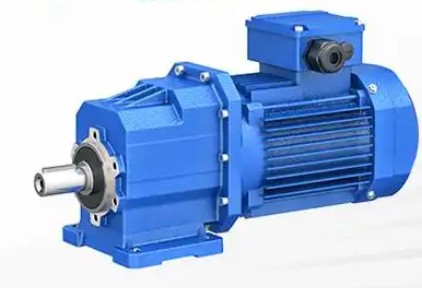
Exceeding the allowable radial or axial load of the gearbox can lead to premature bearing damage, bending or even fracture of the output shaft, thereby shortening the service life of the equipment.
2、 Calculate the load under actual working conditions
When selecting, you need to calculate the force acting on the output shaft based on the actual application scenario.
1. Radial force calculation
When using transmission mechanisms such as pulleys, sprockets, or gears, radial forces are inevitably present. A basic calculation formula is as follows:
W = (K × T × f) / y
W: Radial load [N]
T: Torque of gearbox output shaft [N · m]
y: Effective radius of transmission components (such as pulleys) [m]
K: Driving mode coefficients (e.g. different coefficients for flat belts, V-belts, and chains)
f: Usage factor (considering operating conditions such as starting and stopping frequency)
A crucial detail is that the allowable radial load value of the reducer is not fixed and is directly related to the length of the force point from the shaft end. The closer the force point is to the gearbox body (i.e. closer to the internal support bearings), the greater the radial force it can withstand, similar to the pivot principle of a "seesaw". Therefore, when consulting the gearbox sample, it is necessary to confirm the allowable radial load value based on your actual force position.
2. Axial force calculation
The calculation of axial force is more complex and usually directly related to specific applications. For example, in helical gear transmission, gear meshing itself generates axial force, which is related to factors such as the transmitted torque and the helix angle of the gears. For selection, it is more common to evaluate the thrust or tension directly applied to the shaft by external loads.
3、 Review and verify the sample parameters of the gearbox
After calculating the radial force (W) and axial force under actual working conditions, the next step is to refer to the official selection sample of the RC series reducer.
Search for the "Allowable Radial Load" and "Allowable Axial Load" tables: The sample will provide the allowable load values for different machine models and reduction ratios.
Perform verification: Compare the actual load you calculated with the allowable values in the sample. To ensure safety and service life, the actual load must be less than the allowable value given in the sample.
4、 The impact of bearing configuration
The load-bearing capacity of a gearbox fundamentally depends on the configuration of its internal bearings. The bearing selection of different series or models of reducers may vary to adapt to different application scenarios.