What are the key parameters to consider when selecting a DFY hard tooth conical cylindrical gear reducer
When selecting a DFY hard tooth surface conical cylindrical gear reducer, the following key parameters should be considered:
1. Transmission series and model series
The DFY series is a four stage hard tooth surface conical cylindrical gear reducer, suitable for transmission devices with input and output shafts arranged vertically. When selecting, it is necessary to confirm whether it requires a four stage transmission to avoid confusion with DBY (second stage) and DCY (third stage).
2. Nominal transmission ratio (reduction ratio)
The transmission ratio range is usually 90-500, with specific optional values including 90, 100, 112, 125, 140, 160, 180, 200, 224, 250, 280, 315, 355, 400, 450, 500, etc. Accurate matching is required based on the output speed and torque requirements.
3. Center distance and specifications
The specifications are expressed in terms of the center distance of the final stage, and common specifications include DFY160、DFY180、DFY200、DFY225、DFY250、DFY280、DFY320、DFY360、DFY400、DFY450、DFY500、DFY560、DFY630、DFY710 Wait. The larger the center distance, the stronger the bearing capacity.
4. Rated power and allowable torque
Rated power range: 1-800 kW
The allowable torque can reach 10000 N · m or more (such as DFYK160)
The selection should be adjusted based on the load characteristics of the driving equipment, such as uniform load, moderate impact, and strong impact.
5. Input speed and working environment temperature
The input speed generally does not exceed 1500 rpm
The working environment temperature range is -40 ℃ to+50 ℃. When it is below 0 ℃, the lubricating oil needs to be preheated to above 10 ℃.
6. Assembly type and output shaft rotation direction
The assembly types are divided into various types such as I, II, III, IV, etc., and need to be selected according to the installation space and connection method
The rotation direction of the output shaft can be clockwise (S), counterclockwise (N), or bidirectional (T), which should be matched with the equipment.
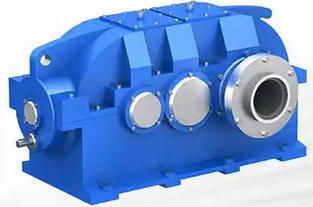
7. Cooling method and lubrication
Generally, oil pool lubrication and natural cooling are used
When the thermal power is not sufficient, circulating oil lubrication or installing cooling coils can be optional.
8. Application industry and load type
Widely used in metallurgy, mining, chemical industry, building materials, lifting and transportation, power, energy and other industries, reliability verification needs to be carried out in combination with specific working conditions (such as continuous operation, frequent start stop).