Selection principles of PLX series planetary gearbox
To select the PLX series planetary gearbox, it is necessary to follow a systematic principle to ensure that the gearbox perfectly matches your application needs and achieves efficient, stable, and long-lasting operation. The selection process can be summarized into the following four core steps:
1、 Clarify application requirements
Before starting the selection process, it is important to have a comprehensive understanding of the operating conditions of your equipment, which is the foundation for all calculations and selections.
1. Power demand
Torque: How much rotational force is required for the device to drive the load? For example, a robotic arm that carries heavy objects requires a greater output torque than a conveyor belt.
Speed: How fast does your device ultimately need to output speed? Motors typically have high speeds (such as 3000 revolutions per minute), but equipment may require lower speeds.
2. Accuracy requirements
How high does your application require for positioning accuracy? For example, laser cutting machines and medical equipment require extremely high precision, while ordinary mixing equipment can relax their requirements.
3. Installation environment
Work schedule: Does the equipment run continuously for 24 hours, 8 hours a day, or frequently start and stop? Continuous or impact working conditions require a higher safety factor.
Environmental conditions: Is there humidity, dust, corrosive substances, or extreme temperatures present? This determines whether special sealing (such as IP65 protection level) or material (such as stainless steel) is required.
2、 Calculate core parameters
Calculate and determine key parameters based on clear requirements.
1. Determine Reduction Ratio
Definition: The ratio of input speed to output speed.
Calculation formula: Reduction ratio=Rated motor speed/Equipment required output speed
Explanation: The reduction ratio determines the ability of the gearbox to reduce speed and increase torque. The PLX series typically offers reduction ratios ranging from 3 to 100 or even higher.
2. Verify output torque
(1) Core principle: The rated output torque of the reducer must be greater than the actual required torque of the equipment, and a certain safety margin must be left.
(2) Calculation formula: Theoretical output torque ≈ Motor rated torque × Reduction ratio × Transmission efficiency
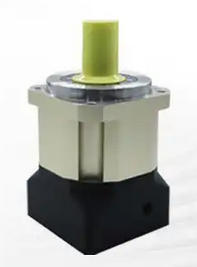
The transmission efficiency of planetary gearboxes is usually between 95% and 98%.
(3) Safety factor: Considering equipment startup, acceleration, or unexpected impact, it is recommended to multiply the calculated theoretical torque by a safety factor of 1.5~2 to ensure that the gearbox does not "pull a big car with a small horse".
3、 Verify key indicators
After determining the reduction ratio and torque, it is necessary to verify the following key indicators.