How to Assess the Wear Degree of Gears in ZLYJ Series Reducers Through Sound
1、 Basic preparation before listening to music
1. Prepare a long handled listening pin or screwdriver, with the blade pressed against the meshing area of the gear box, and listen to the sound with the ear to avoid environmental noise interference.
2. First, disconnect the coupling and run the motor without load to eliminate the interference of abnormal noise from the motor itself; Load in steps of 25%, 50%, 75%, and 100%, and record the sound changes under different loads.
3. Confirm in advance that the anchor bolts are not loose and the coupling is aligned properly, and eliminate false abnormal noises caused by external factors.
2、 Classification of sound with different degrees of wear and tear
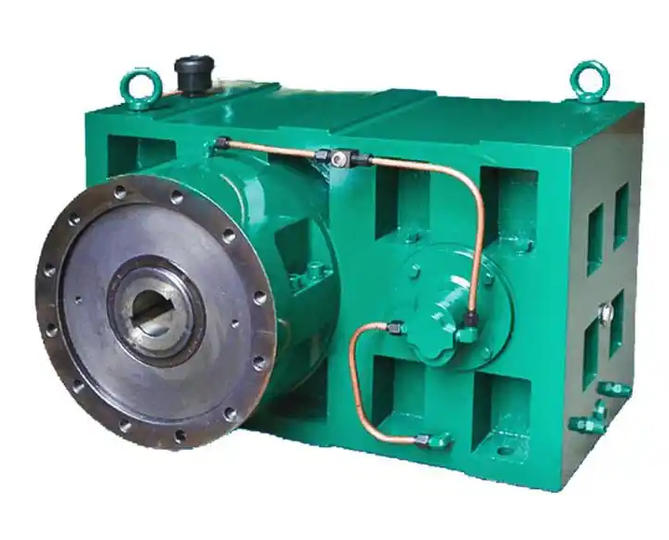
1. Initial slight wear (slight scratches on the tooth surface/no obvious pitting): There is almost no abnormal noise during no-load operation, and a very subtle continuous "rustling" friction sound is emitted from the meshing area when fully loaded. The sound is smooth and has no impact, and the frequency is completely synchronized with the gear meshing frequency. At this time, the vibration speed is usually ≤ 4.5mm/s, there is no obvious abnormality in the oil temperature, and only very fine metal powder can be found in the oil, which belongs to early wear that can be reversed through oil change maintenance.
2. Moderate pitting wear on the tooth surface: A uniform and continuous "clucking" friction sound can be heard without load, and the sound increases synchronously with the increase of speed. After the load increases, the sound volume increases significantly, without strong periodic impact sensation. At this time, the vibration speed has increased to 4.5-7.1mm/s, and the temperature of the local box has slightly increased. A small amount of small sheet-like metal abrasive particles can be found in the oil, and scattered pitting pits have appeared on the tooth surface. A planned maintenance needs to be arranged.
3. Severe tooth surface peeling/excessive tooth clearance: The sound becomes a clear periodic "click click" meshing impact sound, with a rhythm strictly synchronized with the low-speed output shaft speed. There is one obvious impact per revolution, which can be heard directly when standing next to the equipment without load. At this time, the vibration speed exceeds 7.1mm/s, and the gearbox oil temperature quickly rises to above 70 ℃. Blocky metal debris with a size greater than 0.3mm can be found in the oil, and the tooth surface peels off in large areas, and the meshing backlash far exceeds the standard value. It is necessary to immediately stop the machine and replace the gear pair.
4. Extreme wear and tear failure stage: The sound completely turns into a chaotic mixture of intense metal friction and impact, and the originally fixed periodic rhythm completely disappears. Accompanied by sharp metal dry friction whistling, the equipment as a whole experiences strong shaking. At this time, the vibration speed far exceeds 11.2mm/s, and the oil temperature rises to above 80 ℃ in a short period of time. A large number of large pieces of wear and tear can be found in the oil bottom, which may cause serious accidents such as transmission jamming and shaft deformation at any time. Emergency power outage and shutdown are necessary.
3、 Key points of auxiliary verification
1. Compared with historical operating noise data, if the noise suddenly increases by more than 10dB under the same operating conditions, it can be basically determined that gear wear has made significant progress.
2. Combined with oil ferrography analysis, when the iron content shows an accelerated growth trend, the corresponding wear is rapidly developing from the initial stage to severe.