What Affects Eccentric Sleeve Adjustment Accuracy in Cycloidal Pinwheel Drives?
For the BLEY2215-121-1.5KW cycloidal pinwheel reducer, the eccentric sleeve adjustment method is the primary means of controlling meshing clearance between the cycloidal gear and pin teeth. Given that cycloidal reducers demand tight clearance tolerances—typically maintained within 0.05–0.15 mm—the achievable adjustment accuracy is governed by two categories of factors:
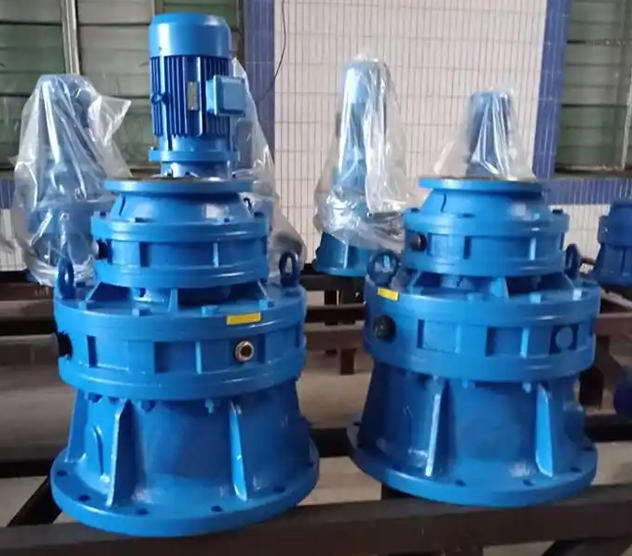
I. Manufacturing Quality of the Eccentric Sleeve (Intrinsic Factors)
As the core adjustment component, the eccentric sleeve's machining precision sets the fundamental floor for adjustment accuracy. Three key geometric tolerances are critical:
-
Eccentricity Tolerance: The offset between the inner and outer bore centers (typically 3–5 mm for the BLEY2215 model) is subject to machining tolerances (e.g., ±0.01 mm). When the required adjustment step is smaller than the sleeve's own tolerance band, further fine-tuning becomes physically impossible—for example, attempting a 0.005 mm adjustment with a ±0.01 mm tolerance part.
-
Coaxiality Deviation: Misalignment between the inner bore (shaft interface) and outer circle (cycloidal gear interface) beyond acceptable limits (e.g., >0.008 mm) introduces parasitic lateral displacement during rotation, causing the actual meshing gap to deviate from the theoretical value.
-
End Face Perpendicularity: If the end face is not sufficiently perpendicular to the axis (e.g., >0.01 mm/100 mm), axial tilt occurs during assembly, resulting in uneven tooth contact across the meshing face and degrading effective clearance control.
II. Operational Variables (Extrinsic Factors)
Even with a perfectly manufactured sleeve, adjustment outcomes are highly sensitive to the tools and techniques employed during setup:
-
Locking Screw Torque Control: Post-adjustment locking of the eccentric sleeve (via M6–M8 hex socket screws) requires consistent torque application. Over-tightening can induce micro-deformation of the sleeve, while under-tightening risks slippage under load. In practice, inconsistent torque has been observed to shift the set eccentricity by 0.01–0.03 mm.
-
Angular Positioning Precision: Since clearance variation follows the relationship Δ=2e×sin(θ/2) (where e = eccentricity, θ = rotation angle), precise angular control is essential. Without dedicated indexing tools (e.g., graduated dial or dial indicator), relying on visual estimation can introduce angular errors of ±5°, which—assuming e = 4 mm—translates to a clearance deviation of approximately 0.35 mm, far exceeding the acceptable tolerance band.
-
Repeat Positioning Error: The transition fit (typically H7/js6) between the eccentric sleeve and output shaft inherently allows minor play. During iterative "loosen–adjust–lock" cycles, this clearance can cause the sleeve to settle in slightly different positions each time, accumulating errors of 0.005–0.01 mm per iteration.