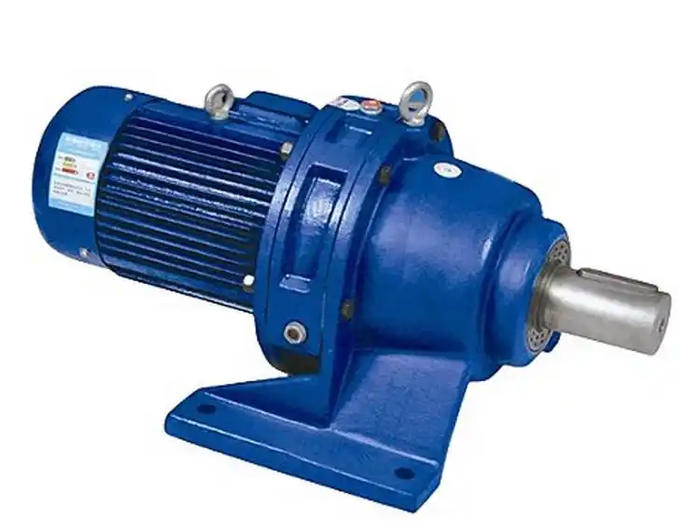
Which Quenching Method Is Optimal for XWD9105-29-2.2KW Cycloidal Gears?
For the cycloidal gear of the XWD9105-29-2.2KW reducer, carburizing and quenching is the most suitable heat treatment method. It delivers the best balance between surface hardness and core toughness, making it particularly well-suited for applications demanding high wear resistance and impact resistance.
1. Core Advantages of Carburizing and Quenching
-
Deep hardened layer with smooth transition: The carburized case depth typically ranges from 0.5 to 2.5 mm. Surface hardness can reach HRC 58–62, while the core retains a toughness of HRC 30–45, effectively enhancing both impact resistance and fatigue strength.
-
Excellent performance adaptability: This process is ideal for gear components subjected to heavy loads, high impact forces, and severe wear conditions. It ensures that both the surface hardness and core toughness of the part are maintained even under harsh operating environments.
-
Mature and stable process: The complete cycle — carburizing, quenching, and low-temperature tempering — effectively relieves internal stresses. The result is a component with high surface hardness and wear resistance, excellent core toughness, and superior overall mechanical properties.
2. Limitations of Alternative Quenching Methods
-
High-frequency induction quenching: The hardened layer is relatively shallow (0.3–2 mm), and the transition between the hardened surface and the core is abrupt. This steep gradient is prone to stress concentration, resulting in comparatively weaker impact resistance. It is therefore less suitable for high-impact, heavy-load applications.
-
Vacuum quenching: While vacuum quenching minimizes oxidation and distortion, the surface hardness and wear resistance it achieves may not match those of carburizing and quenching. Additionally, the process cost is significantly higher.
3. Process Optimization Recommendations
-
Material selection: High-carbon chromium bearing steel such as GCr15 is recommended, with a carbon content of 0.95%–1.10% and a chromium content of 0.90%–1.20%, to ensure adequate hardenability and wear resistance.
-
Process parameters: The recommended carburizing temperature is 900–950 °C, with a target case depth of 0.5–2.0 mm. The optimal surface carbon content of the carburized layer should be maintained at 0.85%–1.05%.
-
Equipment selection: A vacuum carburizing furnace is recommended. After evacuating the chamber, carburizing gas is introduced to carry out the process, resulting in excellent surface quality and faster carburizing rates.
4. Common Defects and Prevention
-
Insufficient hardness: May be caused by an inadequate quenching cooling rate, insufficient heating temperature, or insufficient holding time. Proper process parameter control is essential to avoid this issue.
-
Soft spots: Localized areas on the workpiece surface with abnormally low hardness after quenching. These can be detected by file testing — the file will "bite" into the soft area more easily than into properly hardened regions.
-
Overheating and overburning: Excessively high temperatures or prolonged heating can cause austenite grains to grow and coarsen, leading to coarse martensite formation upon quenching. This significantly degrades the mechanical properties of the gear.
5. Summary
Carburizing and quenching is superior to alternative methods in terms of hardened layer depth, performance adaptability, and process maturity. It effectively enhances both the wear resistance and impact resistance of cycloidal gears, making it the ideal heat treatment choice for the XWD9105-29-2.2KW reducer cycloidal gear.