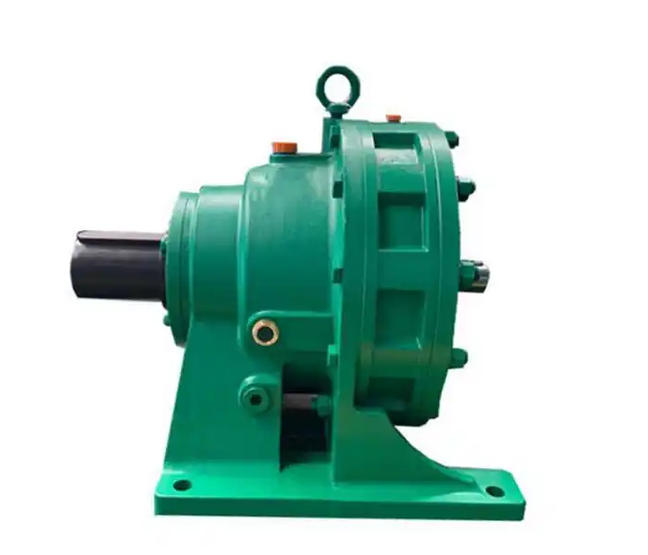
installation orientation, technical parameters & maintenance guide for BWD series cycloidal pinwheel reducer
1. Installation Orientation
In
the BWD series, "B" stands for B-series cycloidal reducer, "W"
indicates horizontal (foot-mounted) installation, and "D" denotes direct
motor coupling. For horizontal mounting, the reducer base must sit
flush on the foundation with a tilt angle not exceeding 15°; beyond
this, anti-leakage measures are required. The vertical counterpart is
the BLD series (flange-mounted, output shaft pointing downward), which
demands strict oil supply monitoring. During installation, the lifting
point and breather plug must face upward. Use steel or cast-iron shims
(no more than three, arranged symmetrically) to level the unit. Never
hammer a coupling or pulley directly onto the output shaft — always use
the threaded hole at the shaft end to press-fit components.
2. Core Technical Parameters
The
BWD series covers a power range of 0.37 kW to 55 kW, with output torque
from 150 N·m to 20,000 N·m. Single-stage reduction ratios span 9 to 87;
double-stage ratios reach 121 to 7,569. Transmission efficiency for
single-stage units can reach 94%, with a rated input speed of 1,500
r/min (1,000 r/min for models above 18.5 kW). Common frame sizes range
from BWD1 to BWD450. Core components are made from high-carbon alloy
steel with quenching treatment, housed in high-strength cast-iron
one-piece casings.
3. Maintenance Essentials
Use
40# or 50# mechanical oil at normal temperature, or 70#/90#
extreme-pressure gear oil. Keep the oil level at the midpoint of the
sight glass. Replace the oil and flush internal residue after the first
100 hours of operation; thereafter, change every six months under 8-hour
daily duty, or every 1,500–2,000 hours for continuous operation.
Routine checks should cover oil level/quality, seal integrity, bearing
wear, fastener tightness, and temperature rise (max 45°C under load;
shut down immediately if it exceeds 50°C). Vertical models require extra
vigilance against oil starvation, and dusty or humid environments
demand frequent oil seal inspections.
4. Frequently Asked Questions
Q: How to distinguish BWD from BLD?
BWD
is horizontal (foot-mounted); BLD is vertical (flange-mounted).
Orientation directly affects lubrication — choosing the wrong type may
cause oil leakage or premature bearing failure.
Q: Can parts from different manufacturers be interchanged?
No.
Cycloidal discs and needle-tooth sleeves have extremely tight
tolerances (often ±0.01 mm). Same-model products from different makers
are not interchangeable — always verify the original part number during
repairs.
Q: Any special requirements for cycloidal disc installation?
The
two cycloidal discs must be used as a matched pair, with the stamped
side facing up. The markings on the two discs must be offset by 180°.
Incorrect orientation will compromise transmission performance.