How to choose the output shaft form when selecting FGA series planetary reducer
When selecting the output shaft form for the FGA series planetary gearbox, the core is to match your equipment operating conditions and transmission requirements. There is no absolute goodness or badness in selection, the key is' suitability '.
Usually, there are three main output forms of planetary gearboxes, which you can choose according to specific application scenarios:
1、 Shaft output (solid shaft)
This is the most common and universal form, with the output end being a solid shaft with a keyway.
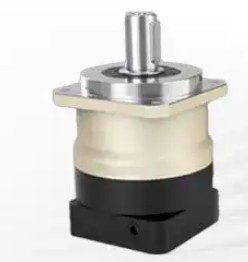
1. Axis output characteristics:
High installation requirements: precise coaxial alignment with the load end is required, and installation is relatively complex. If the alignment is not accurate, long-term use may lead to bearing wear or oil leakage.
Strong flexibility: It is easy to install transmission components such as gears, synchronous pulleys, sprockets, etc. at the shaft end.
2. Applicable scenarios for axis output:
In situations where synchronous belts, gears, sprockets, and other transmission components need to be installed.
Non standard layout for long-distance power transmission or multi axis separation.
General operating conditions that are cost sensitive and do not require strict installation accuracy.
2、 Flange output
The output end is a flange with standard bolt holes, typically compliant with international standards such as ISO 9409.
1. Characteristics of flange output:
Easy to install: It adopts a stop centered and end face fitting installation, with uniform force distribution, simple installation and high precision, which can effectively avoid the risks caused by improper installation.
Strong rigidity: The structure can provide higher torsional rigidity, withstand greater axial forces and bending moments, and is suitable for high-speed, high torque, and frequent start stop working conditions.
2. Applicable scenarios for flange output:
High speed, high torque, heavy load or impact load conditions.
Precision positioning equipment with strict requirements for transmission accuracy and reverse clearance, such as multi axis robotic arms.
Scenarios that require compressing assembly time and reducing installation failure rates.
In situations where the arm is long and the load is high.
3、 Hole output (hollow shaft)
The output end is a shaft with a central hole that can be directly fitted onto the driven shaft, usually using an expansion sleeve for locking and fixing.
1. Hole output characteristics:
Compact structure: It can be directly fitted onto the load shaft, eliminating the need for couplings and other connecting components, making the overall structure more compact and saving installation space.
Good alignment: relatively easy to install, easy to ensure alignment accuracy.
2. Applicable scenarios for hole output:
Commonly used for directly connecting ball screws or drive rollers.
Due to limited installation space, it is necessary to simplify the scenario of the transmission chain.