What Should Be Considered When Selecting Gear Parameters for the ZSH145 Soft Tooth Surface Reducer?
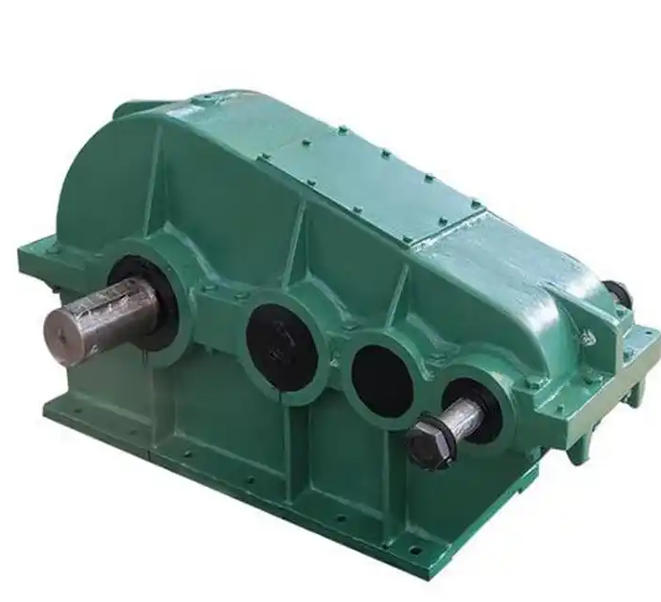
The ZSH145 is a cylindrical gear reducer featuring soft tooth surface gears. These gears are typically manufactured from materials such as 45 steel or 40Cr, followed by quenching and tempering treatments to achieve a tooth surface hardness of ≤ 350 HBW. When selecting gear parameters, engineers must comprehensively balance load-bearing capacity, transmission stability, manufacturability, and overall machine adaptability. The following specific precautions should be observed:
1. Module Selection
The module must be prioritized based on load capacity, ensuring compliance with both tooth root bending fatigue strength and tooth surface contact fatigue strength. For the ZSH145 power range, the module must be carefully matched with the center distance. An excessively small module can lead to inadequate tooth root strength, while an oversized module may result in excessive gear volume and reduced meshing overlap. Furthermore, considering the machining accuracy achievable after quenching and tempering, the module should not be too small, as this would significantly increase manufacturing difficulty.
2. Number of Teeth and Transmission Ratio Allocation
The total transmission ratio must align with the design speed ratio range of the ZSH145 reducer. For single-stage transmissions, a ratio of 1 to 5 is recommended. In multi-stage configurations, transmission ratios should be evenly distributed across stages to ensure balanced gear loading. To prevent root undercutting, the pinion (small gear) must have a minimum of 17 teeth, with an optimal range of 20 to 30 for soft tooth surface gears. The tooth count ratio between the large and small gears should be an integer or near-integer to minimize meshing impact. Additionally, the tooth counts must be coordinated to match the center distance dimensions of the gearbox housing.
3. Tooth Width Coefficient Selection
The tooth width coefficient should be determined by the gear's shaft arrangement. For cantilever arrangements, a smaller coefficient (0.2–0.4) is recommended, whereas symmetrical arrangements can accommodate a larger coefficient (0.4–0.6). The gear tooth width must be matched to the shaft's stiffness; an excessively wide tooth can cause uneven load distribution along the tooth face, leading to biased loading. While soft tooth surface gears can tolerate a slightly larger tooth width coefficient, the tooth load distribution coefficient must still be rigorously verified.
4. Profile Shift (Displacement) Coefficient Selection
Angle profile shift is generally preferred. Selecting an appropriate profile shift coefficient enhances both tooth surface contact strength and tooth root bending strength, while also reducing the meshing sliding rate. The pinion should utilize a positive profile shift to prevent root undercutting and increase tooth root thickness, whereas the large gear can employ a negative profile shift to maintain the required center distance within the housing. It is also critical to monitor the top clearance after profile shifting to prevent lubrication issues caused by insufficient clearance.
5. Accuracy Grade Selection
For soft tooth surface reducers, a precision grade of GB/T 10095 Level 7 or 8 is recommended, depending on transmission stability requirements. For high-speed operations with strict noise and vibration constraints, Level 7 should be adopted. Lower precision grades can result in significant meshing impact and elevated noise levels, while excessively high precision grades unnecessarily increase manufacturing costs. Special attention must be paid to controlling tooth pitch deviation, tooth profile deviation, and tooth orientation deviation to minimize transmission errors.