What installation details can cause unstable operating conditions in the WP series gear reducers
1. Uneven foundation and insufficient rigidity
Poor flatness of the base, failure to tighten the anchor bolts diagonally, or elastic deformation of the foundation can cause slight displacement of the box under load. The result is that the center distance and axis position of the worm gear are damaged, resulting in vibration, noise, temperature rise, and in severe cases, tooth edge contact.
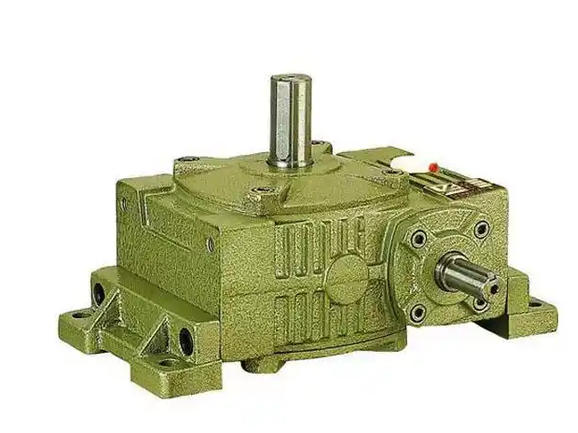
2. Motor reducer load axis alignment difference
Excessive concentricity and angular deviation at the input end can directly cause periodic additional forces. When the input end of the WP reducer is not aligned properly, the axial movement of the worm gear and the bearing bias load will increase, which can easily cause shaking, abnormal noise, and current fluctuations during operation.
It is generally recommended to control the radial/coaxial deviation within a small range and minimize the angular deviation as much as possible; Please refer to the manufacturer's manual for details.
3. Improper assembly of couplings or transmission components
Using a hammer to strike the shaft extension, coupling holes that fit too tightly or too loosely with the shaft, and sprockets/pulleys that are too far away from the bearing will all increase the bending moment at the shaft end and the bearing load. Especially when the cantilever load on the output end is too large, it can easily cause early bearing wear and output shaft vibration.
4. The installation posture does not match the lubrication conditions
The WP series mostly uses oil bath splash lubrication, and different installation postures such as vertical, flange, and inverted can change the oil level and oil seal stress. If oil is still added in a horizontal state, there may be insufficient oil immersion in the worm gear, poor lubrication of the bearings, or high oil level causing oil agitation and heating.
5. The oil level is inaccurate and the vent plug has not been replaced
Excessive or insufficient refueling for the first time can affect the working conditions: insufficient oil will result in insufficient lubrication of the tooth surface and bearings; If there is too much oil, there will be greater oil loss, temperature rise, and oil leakage. More commonly, the transportation dust plug is not replaced with a working breathable plug, and the oil seal is prone to leakage when the pressure inside the box increases.
6. Bolt tightening sequence and torque loss of control
If the anchor bolts, flange bolts, and end cap bolts are not tightened diagonally or with inconsistent torque, it will cause poor fitting of the joint surface, slight deformation of the box body, and loosening of fasteners. After running for a period of time, the risk of vibration and oil leakage will significantly increase.
7. Improper handling of shaft installation, hollow shaft or anti torque bracket
When installing hollow shafts or expansion sleeves, if the shaft tolerance, axial limit, and locking torque do not match, it is easy to experience slip, eccentricity, and additional bending moments. If the anti torque bracket is not set correctly or there is a lack of elastic connection between the bracket and the fixed end of the shaft mounted reducer, vibration and impact will also be transmitted back to the reducer.
8. No no-load or graded loading trial operation was conducted after installation
Running directly at full load after installation may mask issues such as centering, fastening, lubrication, and steering. It is recommended to confirm the correct steering first, then conduct a no-load test run to check for vibration, noise, temperature rise, oil leakage, and fastener status, and gradually load to the rated working condition.