
Four Sea Ltd
sales@reducersgearboxes.com
sales@reducersgearboxes.com

Picking the proper output configuration for FGA series planetary gearboxes hinges on matching your machine’s operating profile and transmission demands. There is no universally superior option. The most suitable choice always depends on how well it fits your real‑world working conditions.
FGA planetary gearboxes offer three mainstream output designs to accommodate diverse industrial use‑cases. Each variant comes with distinct mechanical strengths and ideal application boundaries for you to evaluate.
Solid Shaft Output As the most widely adopted standard configuration, this version features a keyed solid shaft at the output end.
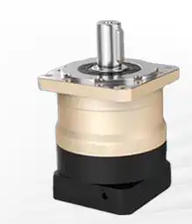
Precise concentric alignment with driven loads is critical for solid‑shaft setups, which raises overall mounting complexity. Misalignment over extended operation accelerates bearing degradation and may trigger lubricant leakage. On the plus side, this layout delivers outstanding adaptability. Gears, timing pulleys, sprockets and other transmission hardware can be fitted directly onto the shaft end without extra modifications.
This output type fits systems fitted with sprockets, timing belts or gear drives. It works well for non‑standard layouts with long‑range power transfer or multi‑axis separated arrangements. It is also a practical pick for cost‑conscious projects where ultra‑tight mounting precision is not mandatory.
Flange Output This design provides a mounting flange machined with standard bolt holes complying with ISO 9409 and other global industrial norms.
Locating shoulders and face‑to‑face contact simplify assembly and distribute mechanical loads evenly. The flange‑mount approach delivers high mounting accuracy and greatly lowers failure risks brought by improper installation. Its robust construction delivers exceptional torsional stiffness, capable of sustaining heavy axial loads and bending moments. It holds steady under high‑speed rotation, elevated torque output and frequent start‑stop cycles.
Engineers commonly specify flange output for high‑speed, high‑torque and heavy‑duty environments with shock loads. It is ideal for precision positioning machinery such as multi‑axis robot manipulators that demand minimal backlash and consistent transmission accuracy. It also helps cut assembly cycle time and minimize installation errors, especially for equipment with lengthy load arms under heavy stress.
Hollow Shaft Output A hollow bore runs through the centre of this output unit. It slides directly over the driven shaft and gets locked securely via an expansion sleeve.
Couplings and intermediate connecting hardware can be omitted entirely. This shrinks overall machine footprint and yields highly compact mechanical layouts. Centering performance remains reliable, and field assembly can be completed with good concentricity with relatively little effort.
Hollow shaft outputs are frequently paired with ball screws and drive rollers for direct power transfer. It is the preferred solution where physical space is restricted and you aim to streamline the whole transmission chain by removing redundant intermediate parts.
Name: Hu Bo
phone:+8618881888393
Whatsapp:+8618881888393
Email:sales@reducersgearboxes.com
Add:No. 10 Xiyuan Road, Hangzhou City, Zhejiang Province, China