Selection of reducer for mining crusher: exclusive configuration scheme for heavy-duty impact
In the fields of mining and building materials processing, crushers are the heart of the entire production line. However, due to uneven hardness of the ore, sudden changes in feed particle size, and frequent start stop operations, the crusher is subjected to extreme working conditions of strong impact, high dust, and continuous heavy load for a long time. As the core transmission component, the selection of the reducer directly determines the operational stability and maintenance cost of the equipment. Faced with instantaneous impact loads that are often several times the rated torque, traditional universal reducers are often unable to handle them, and are prone to fatal failures such as tooth breakage, bearing fracture, and even box cracking. Therefore, developing a dedicated configuration plan for heavy load impact is the key to ensuring efficient production in mines.
1、 Core pain points and structural selection logic
The typical operating characteristics of mine crushers are "instantaneous overload" and "periodic impact". When unbreakable objects (such as iron blocks) enter the crushing chamber, the load torque can instantly soar to 300% to 500% of the rated value. Under such harsh conditions, the primary principle of selection is to enhance impact resistance and torque reserve.
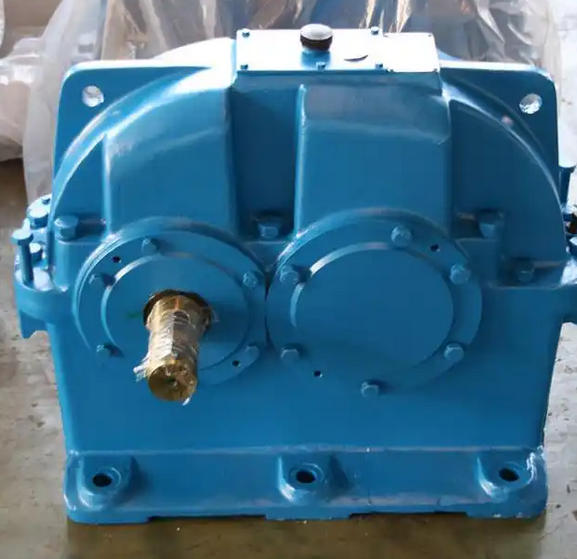
In terms of structural types, cycloidal pinwheel reducers and shaft mounted cylindrical gear reducers are the preferred choices for dealing with such working conditions. The cycloidal pinwheel reducer, with its multi tooth simultaneous meshing structural characteristics, naturally has strong load balancing ability and shock absorption effect, which can easily resist instantaneous impacts and avoid equipment failure; At the same time, its high torque density is very suitable for compact installation spaces on mining sites. In addition, the ZJY series shaft mounted cylindrical gear reducer, specially designed for equipment such as hammer crushers, also performs well. It can be directly mounted on the main shaft, eliminating intermediate links such as couplings, simplifying the installation process. Its sturdy box structure and high-strength gears can effectively absorb high-frequency vibrations and impact loads. In contrast, traditional helical gear reducers are more prone to shell fatigue cracking under repeated impacts and require extra caution in evaluation.
2、 Scientific verification and safety margin of key parameters
The underlying logic of selection lies in achieving precise matching between operating conditions and parameter systems, and avoiding blindly applying conventional safety factors. For strong impact heavy load scenarios, an independent safety factor calculation model must be established.
The basic safety factor usually needs to be set at 2.5 or above. If the equipment is operating continuously for 24 hours or the ambient temperature is high (such as in high-temperature mining areas in summer), a correction value of about 0.5 needs to be added on this basis, and the final safety factor should reach 3.0. This means that if the peak impact torque of the crusher is 4000 N · m, the rated output torque selection of the reducer must be greater than 12000 N · m. In addition, torsional rigidity and temperature rise are also important indicators that cannot be ignored. Although ordinary heavy-duty scenarios have relatively lenient requirements for rigidity, sufficient support stiffness still needs to be ensured to ensure smooth transmission; In high-speed, heavy-duty or high-temperature environments, a forced cooling system or constant temperature oil circuit must be equipped to prevent lubrication failure and gear bonding caused by heat accumulation.