How to avoid base deformation during gearbox installation
The key to avoiding deformation of the base during the installation of the reducer is to ensure a solid and flat foundation, control installation stress, and provide reasonable support and fastening. The deformation of the base can directly lead to uneven force distribution on the box, axis misalignment, vibration, oil leakage, and even gear damage.
1. Choose a high-strength and high rigidity installation foundation
The base should be made of steel structure or concrete foundation with sufficient thickness, and the bearing capacity should exceed 1.5 times the total weight of the reducer and load. For concrete foundations, it is recommended to maintain for no less than 7 days and have a strength grade of no less than C25 to prevent settlement or cracking.
2. Ensure the flatness of the installation surface
The horizontal error of the installation surface should be controlled within 0.1mm/m (as described). It can be adjusted using a precision level and scraping process to avoid the box being "suspended" or "twisted" due to local height differences.
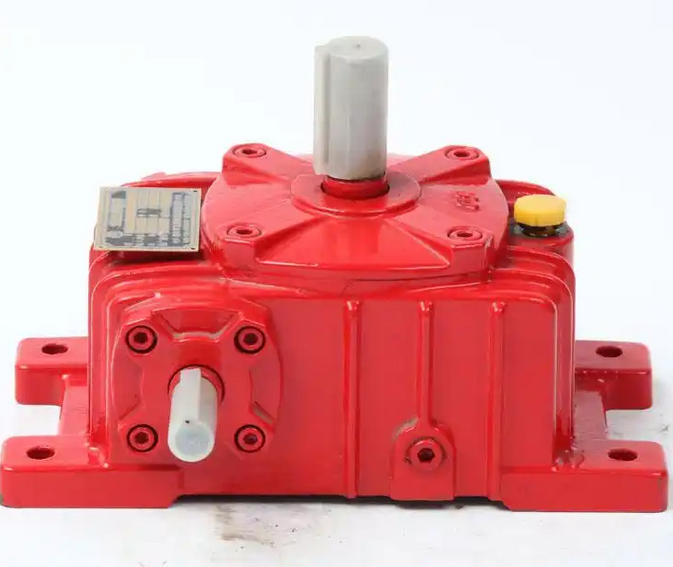
3. Uniformly tighten the anchor bolts to prevent stress concentration
The tightening of bolts must be applied with torque in diagonal order step by step, and it is strictly prohibited to tighten single-sided bolts at once. It is recommended to use a torque wrench to ensure that the manufacturer's specified pre tightening force is achieved, in order to avoid local deformation of the base due to over tightening or unevenness.
4. Install shims or vibration dampers for stress compensation
If there are slight unevenness in the base, metal gaskets (rather than wood or plastic) should be used for filling, and the gasket area should not be smaller than the contact surface around the bolt hole. If necessary, vibration damping pads (as mentioned) can be installed to absorb dynamic loads during operation and reduce impact on the base.
5. Avoid applying additional stress to external pipelines or transmission components
The connected couplings, pulleys or pipelines shall not apply axial or radial thrust to the gearbox body. For example, if a rigid coupling is pressed too deeply, it will generate axial force, causing the end cap to crack (as described). Flexible couplings should be used with appropriate clearance.
6. Regular inspection and maintenance
After long-term operation, the anchor bolts may loosen due to vibration, resulting in uneven re stressing of the base. It is recommended to check the bolt tightening status every 500 hours of operation and retest the levelness.