What are the criteria for selecting materials for gearbox shaft components
1. Core mechanical performance standards
The reducer shaft mainly bears torsional, bending, and alternating loads during operation, so the material must meet the following mechanical performance requirements:
Strength and stiffness: The material needs to have sufficient yield strength and tensile strength to avoid plastic deformation or fatigue fracture under static or dynamic loads.
Resilience and wear resistance: Good toughness is required to cope with impact loads and prevent brittle fracture; At the same time, friction parts such as the shaft neck need to have high wear resistance.
2. Material selection standards based on shaft diameter size and hardenability
The size of the shaft directly determines the "hardenability" during heat treatment (i.e. whether the material can harden together from the surface to the center), and the industry often forms the following selection rules based on the size of the shaft diameter:
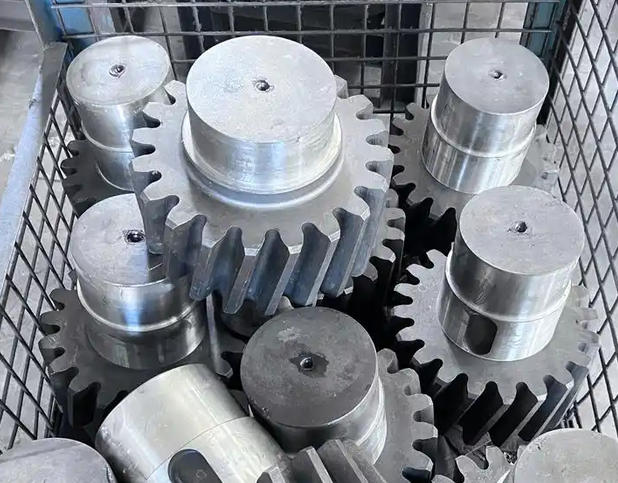
Small size shaft (diameter<30mm): 45 steel (carbon structural steel) is usually selected. It has low cost, easy processing, and can meet light or medium load requirements.
Medium sized shaft (diameter 30-80mm): 40Cr (low-alloy steel) is usually selected. It has moderate hardenability, balanced strength, toughness, and fatigue performance, and is the preferred choice for most conventional gearbox shafts.
Large or heavy-duty shafts (diameter>80mm): 42CrMo or 40CrMo (high-strength alloy steel) are usually selected. This type of material has high hardenability and is suitable for withstanding large bending moments, large torques, and harsh working conditions.
3. Material selection standards based on working load levels
The material selection will be differentiated based on the power transmitted by the reducer and the degree of impact it can withstand
Light load/medium low speed working conditions: High quality carbon structural steel (such as 45 steel) is often used, which can be quenched and tempered (quenched+high-temperature tempered) to meet the requirements. The tensile strength generally needs to be ≥ 380MPa.
Heavy load/high-speed/impact conditions: Alloy structural steel (such as 40Cr, 42CrMo, 20CrMnTi, etc.) is commonly used. This type of material undergoes quenching and surface hardening treatment (such as carburizing, high-frequency quenching, or nitriding), with a surface hardness of HV500 or higher, maintaining high toughness in the core and longer fatigue life.
4. Special environmental adaptability standards
When the gearbox is in extreme or special working environments, the material must meet specific physical or chemical standards:
Corrosive environment: such as chemical, marine, or cooling tower environments, stainless steel (such as 1Cr18Ni9Ti, 304, 316, etc.) or surface anti-corrosion coating treatment (such as galvanizing, spraying epoxy resin, fluorocarbon topcoat, etc.) should be selected.
High temperature environment: For aircraft engines or gas turbine reducers, high-temperature resistant alloys (such as Inconel alloy) should be selected to ensure that creep does not occur and high strength is maintained at temperatures above 600 ℃.