Working principle and structural characteristics of harmonic reducer
Harmonic reducer is a high-precision, lightweight, and compact precision transmission device widely used in high-end automated precision transmission scenarios. The overall structure of the equipment is minimalist, with the core consisting only of three basic components: wave generator, flexible wheel, and rigid wheel. Compared with traditional reducers, it significantly reduces the number of components, effectively reduces equipment failure rate, and improves operational stability. Its working principle is different from conventional gear rigid meshing transmission, relying on controllable elastic deformation to achieve deceleration operation. During operation, the wave generator continues to rotate as a power input component, forcing the flexible wheel of the thin-walled flexible structure to produce regular and controllable elastic deformation, gradually meshing and staggered transmission with the fixed rigid wheel, and relying on the difference in the number of teeth between the two to achieve precise deceleration transmission with a large reduction ratio.
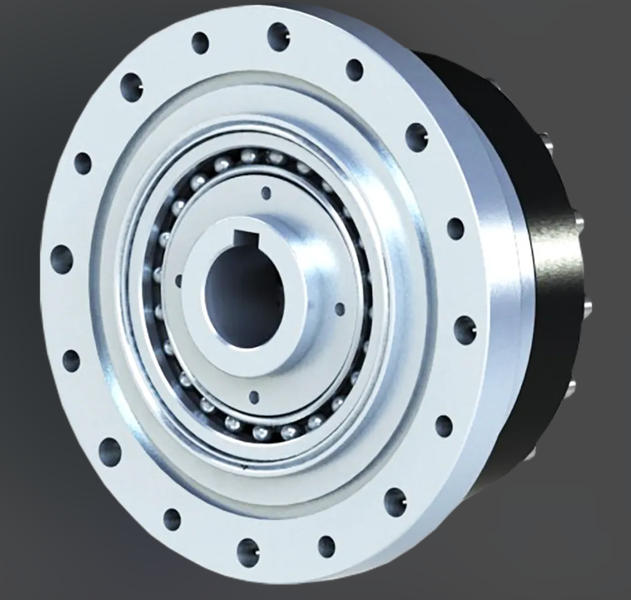
The unique deformation transmission method endows the harmonic reducer with excellent transmission performance. The number of teeth involved in meshing during equipment operation far exceeds that of ordinary reducers, effectively dispersing transmission loads and ensuring a smooth and stable transmission process with almost no impact or jamming issues. Based on this characteristic, the reducer has extremely high transmission accuracy, minimal backlash, and minimal positioning error, which can meet the requirements of micrometer level precision transmission. At the same time, its compact structural design has outstanding advantages. Under the same torque output conditions, its volume and weight are much lower than planetary reducers, greatly saving equipment installation space and adapting to the design requirements of miniaturization and integration of equipment.
In addition, harmonic reducers have excellent comprehensive transmission performance, with multiple advantages such as large single-stage transmission ratio, high transmission efficiency, low operating noise, and high repeatability positioning accuracy. Single stage can achieve a large reduction ratio without the need for multi-stage series transmission, further simplifying the equipment structure; Low transmission loss, high energy efficiency utilization, and significant energy-saving effect during long-term operation; No gear impact noise during operation, suitable for quiet work scenarios. With its core advantages of high precision, small size, and high stability, harmonic reducers have become the key components of high-end automation equipment, widely used in high-end fields such as industrial robots, precision machine tools, aerospace equipment, and automation precision modules that require strict installation space, transmission accuracy, and operational stability.