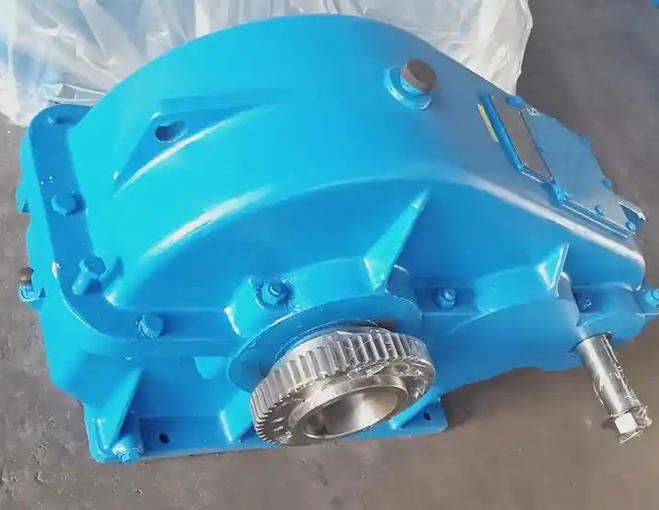
What are the common causes of oil leakage in the JZQ750-40.17 soft tooth surface gear reducer
1、 Direct failure of sealing components
Damaged shaft end oil seal: The skeleton oil seal of the input/output shaft has been corroded by high-temperature oil for a long time, and the shaft neck rotates and rubs, resulting in aging and hardening, lip wear and cracking, and loss of elastic sealing ability; If the oil seal selection is incorrect (using ordinary non oil resistant rubber instead of nitrile rubber), it will accelerate failure and cause oil leakage.
Damaged sealing components on the joint surface: The sealing paper gasket and O-ring at the interface between the upper and lower boxes and the connection between the end caps have fractured and deformed due to long-term vibration and oil corrosion, making it impossible to fill the gaps on the joint surface and causing oil leakage.
2、 Abnormal increase in pressure inside the box
Blockage of the ventilation device: When the oil temperature rises during operation, the air inside the box expands. If the ventilation cap (respirator) is blocked by dust and oil, the internal pressure cannot be released, and the oil will be forcibly squeezed out from all weak seals by pressure. This is one of the most common causes of oil leakage in soft tooth surface reducers.
Overfilling of lubricating oil: When the oil level exceeds the highest mark on the sight glass, the oil is violently stirred and splashed during gear operation. The oil pressure in the box continues to rise, and a large amount of oil flows into the shaft seal, joint surface, and other positions, directly overflowing and leaking.
3、 Processing and structural defects
Insufficient precision of the joint surface of the box body: The interface between the upper and lower boxes is rough and the flatness exceeds the standard, or the shell deforms and bends after long-term heavy load operation, resulting in incomplete fitting of the joint surface and the formation of a through oil leakage gap.
Return oil structure failure: The return oil groove on the inner wall of the box and the return oil hole at the bearing seat are blocked by oil sludge and metal debris, and the lubricating oil splashed onto the inner wall cannot flow back to the oil pool normally. It accumulates and seeps out at the end cover and shaft neck positions.
4、 Improper installation and maintenance operations
Assembly is not standardized: the oil seal is skewed during press fitting, the lip is scratched by the shaft shoulder, or the bolts on the joint surface are not tightened evenly in diagonal order, resulting in uneven stress on the sealing surface and gaps.
Excessive wear of the shaft neck: After long-term operation, grooves with a depth greater than 0.1mm are worn on the surface of the shaft neck in contact with the oil seal, and the oil seal lip cannot fully fit the shaft surface, causing continuous oil leakage along the grooves.
5、 Abnormal operating conditions
Long term severe vibration: The deviation between the reducer and the motor is too large, the base is not firmly fixed, and there is continuous large vibration during operation. This will not only loosen the end cap bolts, but also accelerate the wear and aging of the seals, indirectly inducing multiple oil leaks.
Long term excessive oil temperature: Poor heat dissipation conditions cause the oil temperature to continuously exceed 80 ℃, resulting in a significant decrease in lubricating oil viscosity and increased fluidity, making it easy to penetrate through small sealing gaps. At the same time, high temperatures quickly age rubber seals, forming a vicious cycle.